There is something that happens when people make things together that is difficult to replicate anywhere else. A table fills with cloth, yarn, needles, thread, scissors, half-finished projects, coffee cups and conversation. Someone asks a question. Someone else leans over to demonstrate a stitch. A mistake gets fixed. A story gets told. Another person arrives and makes room at the edge of the table. What looks from the outside like a group of people quietly working with their hands is often something much larger: knowledge moving between people, relationships taking shape, and community being practiced in real time.
Fiber arts have long created spaces like this. Quilting bees, sewing circles, knitting groups and other forms of communal handwork were practical gatherings, but they were rarely only about getting the work done. Before ready-made clothing and household textiles became widely available, sewing, mending, knitting and quilting were necessary skills. Large projects could take enormous amounts of time, so working collectively made sense. A quilt could be assembled more efficiently with several people around a frame, but the work also created an opportunity to talk, exchange news, teach younger makers and reinforce social ties. The object mattered, but so did the gathering around it.
The quilting bee has become one of the most recognizable images of communal fiber work in American history, although the reality was more varied than the nostalgic picture of a dozen women sitting peacefully around a quilt frame. Quilting practices differed across regions, communities, economic circumstances and cultural traditions. Some gatherings were organized around specific projects for a family or neighbor. Others were connected to churches, charitable efforts or social events. Sometimes they were intensely practical. Sometimes they offered women one of the few socially acceptable opportunities to gather beyond the immediate household. The work gave people a reason to come together, but once they were there, the conversation could range far beyond cloth.
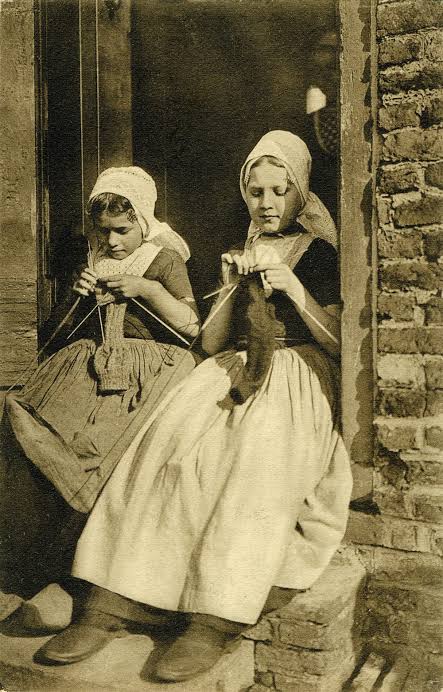
That pattern repeats across textile traditions. Sewing circles offered a place to mend, sew clothing, exchange patterns and pass along techniques. Knitting groups have served as both social gatherings and organized responses to larger events. During World War I, for example, the American Red Cross organized large-scale knitting campaigns in which people across the country made wool garments for soldiers overseas. The organization’s own history describes the campaign as a major home-front effort, and Red Cross youth groups also knitted scarves and prepared other useful goods during the war years. American Red Cross
Those gatherings were not simply recreational. They turned domestic skills into collective action. A person who might not have had political influence, money to donate or access to formal institutions could still contribute time, labor and knowledge. The object produced by one set of hands became part of something larger than the maker. That same pattern continued in community sewing and knitting groups throughout the twentieth century. In southwest Florida, for example, a Red Cross Sewers and Knitters auxiliary traces its roots to 1917 and continued for generations, combining practical making with storytelling, companionship and service. American Red Cross
There is a reason these spaces persist even after the practical necessity of making most household textiles has diminished. Fiber work creates a particular kind of social environment. The hands are occupied, which can make conversation easier. Eye contact is optional. Silence does not automatically feel awkward because everyone has something to do. A newcomer can sit down with a project and participate before they know anyone well. An experienced maker can demonstrate something without needing to stand at the front of a room and formally teach. The structure is loose, but the opportunities for connection are constant.
There is also something deeply egalitarian about the shared table when it works well. A person may arrive with decades of experience in one technique and know absolutely nothing about another. The expert knitter may become the beginner weaver. The confident embroiderer may need help understanding crochet. Skills move in different directions, and nobody remains the expert in everything. That exchange creates a form of interdependence that is easy to overlook because it feels so ordinary. Someone brings an extra tool. Someone remembers the stitch you forgot. Someone knows where to find the right yarn. Someone says, “Let me show you.”
The transfer of knowledge matters because so many fiber traditions have historically been learned this way. Not everything can be captured in written instructions. A pattern can tell you how many stitches to cast on, but it cannot always show you how tension should feel in your hands. A book can describe a seam, but watching someone make it may suddenly make the whole process clear. Much of handwork knowledge lives in gesture, rhythm and repetition. It is learned by seeing, doing and asking questions, often in the company of someone who has done it before.
That is one reason communal making has such staying power. These gatherings preserve skills without turning preservation into something formal or precious. They make room for the beginner, the expert, the person who came to finish a project and the person who came because they needed to be around other people for a while. The work provides the structure, but the real value may be everything that accumulates around it.
Community, after all, is not an abstract idea. It is a practice. It is made through small acts repeated over time: showing up, sharing what you know, making space, asking for help, offering help, listening, returning, bringing someone new to the table. Fiber circles have been doing those things for generations, sometimes in living rooms, sometimes in churches, sometimes in community halls, sometimes in shops, and sometimes around tables that did not exist until someone decided to pull out the chairs.
At Brazos Valley Fiber Arts, that history feels especially relevant because we see the same patterns every time people gather. Someone arrives with a project they are stuck on. Someone else notices and offers a suggestion. A person who came alone gets introduced to the table. One conversation turns into another. Someone learns a new stitch without anyone formally announcing that a lesson has begun. The project may be the reason people walk through the door, but the relationships are often what bring them back.
Maybe that is the quiet power of fiber arts. They give us something to do with our hands while we practice being with one another.
And that may be one of the oldest things cloth has taught us: the work is rarely only about the thing being made.
If You Want to Read More
American Red Cross — Our History
Includes information about the organization’s World War I knitting campaigns and the role of volunteer handwork in relief efforts.
https://www.redcross.org/about-us/who-we-are/history.html
American Red Cross — Contributions of Young Americans
Explores the history of youth participation in the Red Cross, including knitting scarves and preparing useful goods during World War I.
https://www.redcross.org/about-us/who-we-are/history/contributions-young-americans.html
American Red Cross — Sewers and Knitters Auxiliary Group Crafts From the Heart
A look at a community sewing and knitting group with roots dating to 1917 and the way service, handwork and companionship became intertwined over generations.
https://www.redcross.org/local/florida/north-central-florida/about-us/news-and-events/news/Sewers-and-Knitters-Auxiliary-Group-Crafts-From-the-Heart.html