From homespun to secret codes, textiles have been part of public life for a very long time
Election season gave us a good excuse to go looking backward instead of sideways. No candidates. No parties. No comment-section cage match. Just a question: has fiber always had a place in politics and civic life?
Oh, yes.
Yarn, cloth, embroidery and quilting have been expressing opinions for centuries — sometimes loudly, sometimes beautifully, and occasionally while pretending to be an entirely innocent sweater.
Long before campaign T-shirts existed, what people wore could make a political statement. In the American colonies of the 1760s and 1770s, resistance to British taxes included boycotting imported goods, including textiles. Women organized spinning gatherings and produced homespun yarn and cloth, turning work that was ordinarily associated with the household into a very public economic choice. Wearing homespun became a visible way of saying, essentially, we can make this ourselves. The Virginia Gazette reported that nearly 100 women appeared in homespun gowns at a December 1769 ball in Williamsburg.
Think about that the next time somebody tells you clothes are “just clothes.”
Fiber became even more visible during the campaign for women’s suffrage. Marches and public demonstrations were filled with banners that had been sewn by hand. The Library of Congress notes that suffrage banners were painstakingly sewn to identify organizations, carry messages and transform public streets into spaces where women could make themselves politically visible. In Britain, suffrage groups similarly used elaborate embroidered and appliquéd banners, combining skills long associated with women’s domestic work with very public demands for political participation.
There is something wonderfully subversive about that. The needlework itself was familiar and respectable. What the needlework was saying was another matter entirely.
And then we get to one of our favorite historical rabbit holes: knitting spies.
The dramatic story sometimes shared online about a Danish woman named Marta Voss knitting navigational maps for the resistance during World War II appears to be one of those internet stories that becomes more detailed every time it is repeated. We could not verify her in reliable historical records, so we are not going to turn her into history simply because it is a fantastic story.
The same goes for the story of a Belgian woman who sat at her window during World War I, knitting different stitches to record the German trains she watched. It gets repeated on plenty of websites, but when we went looking for a reliable historical record behind it, we could not find one either.
The good news is that reality was strange enough without them.
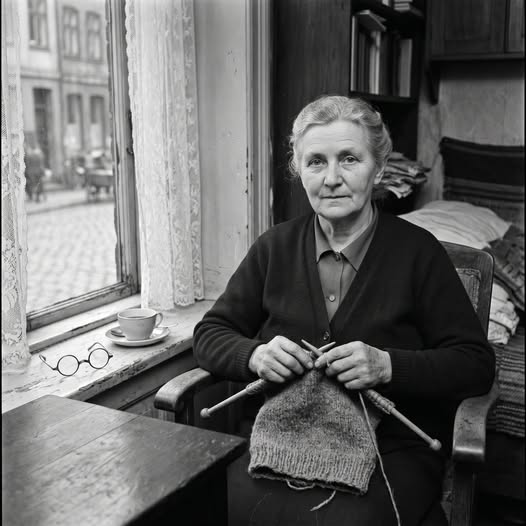
The one that holds up is Phyllis Latour, a British agent who parachuted into Normandy in 1944 as a radio operator for the Special Operations Executive. She posed as a teenage girl selling soap, and according to accounts of her mission, she hid her silk code sheets around a knitting needle tucked into the shoelace that tied up her hair. German soldiers questioned her and never checked. She died in 2023 at the age of 102.
Honestly, if you are a knitter or crocheter, none of this is a stretch. We already know that a page of stitch instructions can look like classified intelligence to everyone else.
During World War I, knitting took on a much more public civic role in the United States. The American Red Cross organized nationwide knitting efforts encouraging people to make socks, sweaters, mufflers and other garments for soldiers. The phrase “Knit Your Bit” became part of the campaign. Knitting was not simply pastime; it was presented as something an ordinary person sitting at home could contribute to a much larger national effort.
Textiles have carried political meaning well beyond Europe and the United States, too. In India, khadi, hand-spun and handwoven cloth, became deeply connected to the independence movement. Gandhi promoted spinning and wearing khadi as an alternative to British-manufactured textiles, tying cloth directly to questions of economic independence and colonial power. By 1921, Indian nationalists had adopted khadi as a symbol of resistance, and a spinning wheel was proposed for the center of an early nationalist flag design.
That may be one of the clearest examples in history of something fiber artists already understand instinctively: materials have stories before we ever begin making with them.
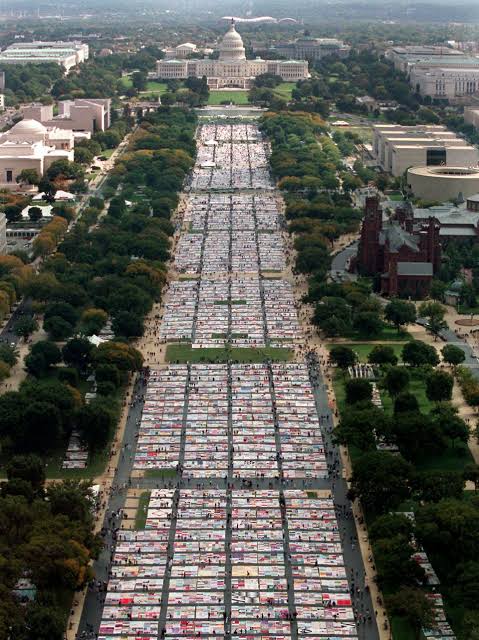
Sometimes the textile itself becomes the public message. The AIDS Memorial Quilt began in the 1980s as a way to make an enormous human loss visible person by person rather than statistic by statistic. When it was first displayed on the National Mall in Washington in 1987, it contained 1,920 individual panels. It continued to grow into tens of thousands of panels, each one made to remember an individual life. Cloth, sewing, embroidery, photographs and personal objects became both memorial and public testimony.
That is the thread running through all of these stories.
Fiber is ordinary. That is part of its power.
A spinning wheel can sit in a home. A banner can begin at a sewing table. Knitting needles attract very little attention. A quilt is one of the most familiar objects imaginable. Yet those same materials have been used to communicate allegiance, resist economic systems, support communities, preserve memory, share information and make people visible.
None of this means your granny square secretly needs a political platform.
Sometimes a scarf really is just a scarf.
But whenever election season rolls around, it is worth remembering that participation in public life has never happened only at podiums or ballot boxes. Throughout history, people have used whatever tools were already in their hands.
And sometimes those tools were needles, thread, cloth and yarn.
Which leaves us with a very Fiber in the Wild question:
If textiles could talk, what would the things we are making right now say about the time in which we live?
Want to Go Farther Down the Rabbit Hole?
History of Fibre and Activism — Stephanie Banszky Creative
A broader exploration of the relationship between textile making and activism, including historic and contemporary fiber projects and the ways cloth can carry public meaning.
Political Spectacle and the Importance of Banners — Library of Congress
A closer look at the handmade banners of the American women’s suffrage movement and how sewn textiles became visual identity, communication, and public presence.
The Art of Stitchable Activism — No Kill Mag
A more contemporary look at what is often called craftivism — knitting, crochet, quilting, and cross-stitch being used for community action, public art, memorial, protest, and social change. This one moves from historical examples into present-day projects, making it an interesting next stop for readers curious about where that tradition has gone.