Fibre arts are intensely visual, but they are just as much about touch. Color may be what catches our eye first, but then we want to feel the yarn: the softness, the loft, the smoothness, the twist, the drape, the weight in our hands. We are trying to understand the material before we ever make the first stitch. But the skein we are holding is the result of a long journey, one that began well before it reached a yarn shop, a festival table, or our project bag.
A skein of yarn has a whole set of industries and hands behind it that we never see. Agriculture and craft, animals and land, equipment and chemistry, design and small business, tradition and technology, all twisted together into something that looks deceptively simple sitting on a shelf. That is what makes the idea of hoof to hook so interesting. The yarn may feel like the beginning of our project, but in reality, it is already the result of an entire chain of work.
Sheep, alpacas, llamas, goats and other fibre animals are living their lives long before we ever encounter what they grow. Their health, breed, environment, care and diet all shape the quality and character of the fibre. Then there is shearing, which is its own skilled practice and one of those jobs that looks far easier when someone experienced is doing it than it actually is.
Once the fleece is off the animal, it still has a long way to go before it resembles the tidy skein we recognize. It has to be cleaned, prepared, processed and spun, often through the hands of a fibre mill that knows how to work with the personality of the material in front of it. One of the fascinating facts about small mills is that they sit right at the intersection between farm and maker. What arrives may be raw fleece that still looks very much connected to the animal it came from. What leaves may be yarn, roving or prepared Fibre ready for someone else to transform.
And then there is color.
This is where perfectly sensible people begin naming yarn things like Storm Over the Prairie, Grandmother’s Garden, or October at Dusk, and the rest of us immediately decide we need it. Hand-dyers bring another whole layer of knowledge and artistry into the process, working with Fibre, chemistry, color relationships and repeatability. By the time a skein reaches a shop or a festival table, it represents the work of different people and small businesses.
That is especially interesting when you begin thinking about local Fibre economies. A fleece might be grown on a nearby farm, shorn by a regional shearer, processed at a small mill, dyed by an independent artist and then sold through a local shop, festival or maker. The yarn is still just yarn, but now it is also part of a little web of agriculture, creativity and commerce that keeps money and skills moving through a community.
Then we get our hands on it.
This is the part we usually think of as the beginning. We choose a pattern, or perhaps we buy the yarn first and spend the next six months claiming we are “waiting for the right pattern,” which is really just Fibre-person language for I wanted it and had absolutely no plan whatsoever. Eventually we start making. We test a stitch. We change our minds. We rip something out. We discover that the yarn behaves beautifully in one pattern and terribly in another. We alter a neckline, change a border, add another color, or decide halfway through that the whole thing wants to become something else.
That process matters too, because the maker becomes another part of the chain. The yarn has arrived with all of its previous history intact, and now we add our own decisions to it. A sweater, shawl, blanket, woven cloth or piece of Fibre art may look like the work of one person, but hidden inside it are many layers of knowledge and labor that existed long before the final maker sat down with a hook, needle or loom.
That is what makes Fibre arts so compelling. They connect worlds we do not always think of as connected. Agriculture meets art. A pasture connects to a dye pot. A Fibre mill connects to a crochet hook. A sheep standing in a field can eventually become a scarf wrapped around someone’s neck, and the people at opposite ends of that journey may never meet.
Understanding that path does not mean we all need to become Fibre-processing experts or interrogate every skein in our stash about its ancestry. It simply makes the material richer. Once you understand even a little of what happens before yarn becomes yarn, it is hard to see it as just another craft supply.
And that is exactly what we will be exploring on Tuesday, November 17, when Brazos Valley Fiber Arts welcomes Krystin Salome of Shear Joy Farm & Shearing for our next Artists at Work program, From Hoof to Hook: Yarn’s Journey from Animal to Project.
Krystin will walk us through the journey from raising Fibre animals and shearing through milling and ultimately into the skeins we know and love. It is a chance to look behind the yarn label and understand how much knowledge, labor and decision-making goes into something we often take for granted once it reaches our project bag.
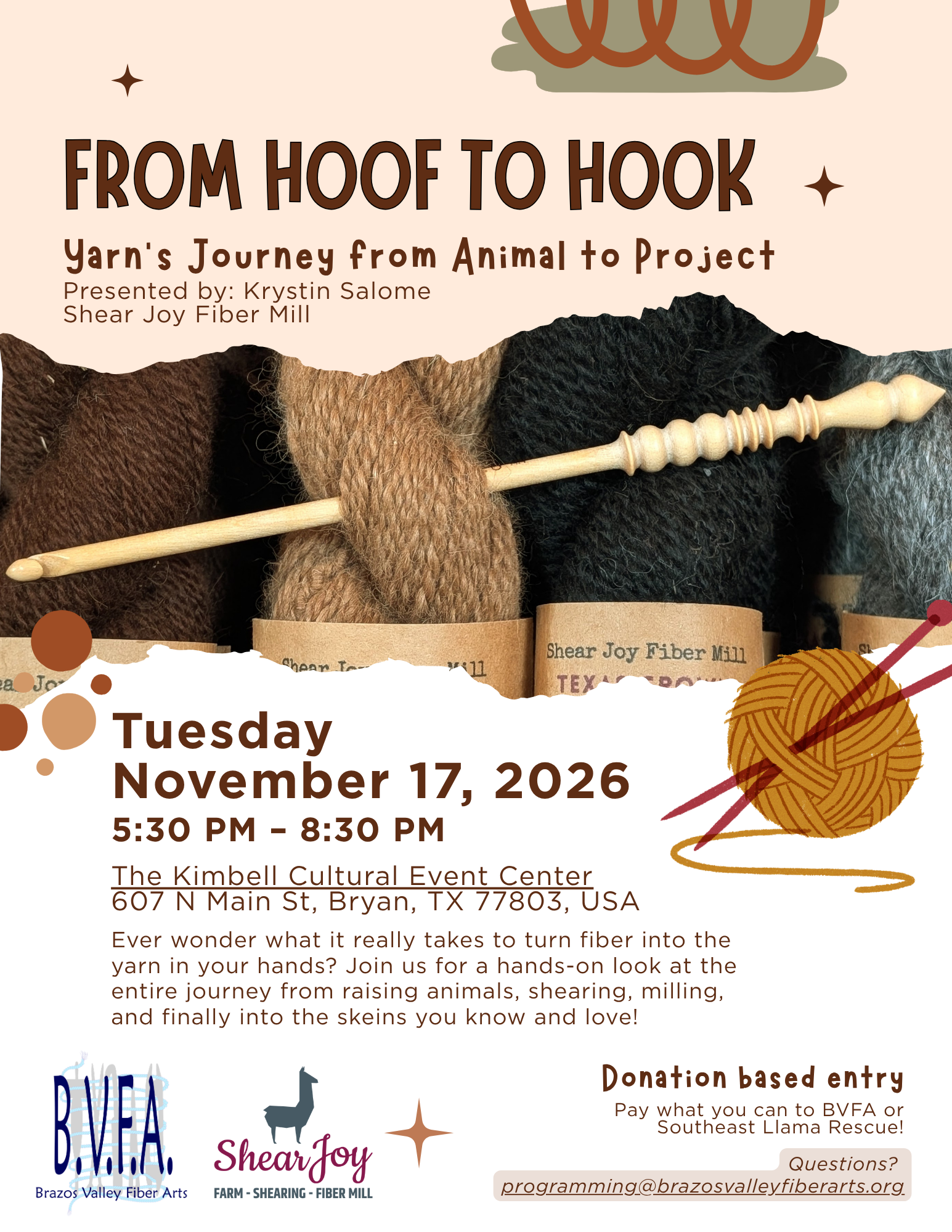
The program will be held Tuesday, November 17, 2026, from 5:30–8:30 PM at the Kimbell Cultural Event Center, 607 N. Main Street in Downtown Bryan. The evening is donation-based, with guests invited to give what they can to Brazos Valley Fiber Arts or Southeast Llama Rescue.
Bring a project—our regular Social Sit-and-Stitch will be happening alongside the program—and bring a friend, your curiosity, and an interest in seeing how the journey from hoof to hook really works.
You may never look at a skein of yarn quite the same way again.